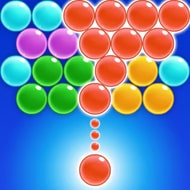
Bubble Shooter does not need levels with named characters or a story to keep players coming back — a cannon, a wall of colored bubbles, and a simple rule about matching three of the same color have been enough to hold attention since the format first became popular decades ago. What separates a beginner’s session from an experienced player’s session isn’t reflexes. It’s almost entirely about reading the board before the first shot ever leaves the cannon.
| Genre |
Match-3 puzzle, arcade shooter |
| Objective |
Clear bubbles by matching three or more of the same color |
| Controls |
Aim with mouse or finger drag, release to shoot |
Aiming and Matching in Bubble Shooter
The cannon sits at the bottom of the board, and every shot is aimed by dragging or moving the mouse to set a trajectory line before releasing. Matching three or more bubbles of the same color pops the group, and popping bubbles that are attached to nothing else causes them to drop off the board entirely for bonus points. Beginners consistently make the same mistake early on: shooting at the nearest visible bubble instead of scanning the whole board first for a larger cluster worth targeting.
Bank shots — bouncing a bubble off the side wall to reach an angle you couldn’t hit directly — are the single most useful technique separating casual players from players who consistently clear boards efficiently. Once the side walls are cleared of bubbles early, later bank shots become easier to line up, which is why experienced players deliberately clean the edges of the board before going after the center.
Swapping between the current bubble and the next one in the queue, when the option is available, lets you avoid wasting a shot on a color that doesn’t match anything reachable.
Fireball and Bomb Power-Ups
Most versions of the game include at least two signature power-ups worth understanding by name. The Fireball clears bubbles in a straight line once triggered, usually earned after popping a set number of bubbles in a row, and it’s most valuable when saved for a moment where a single line shot can cut through a dense wall rather than used the instant it becomes available. The Bomb works differently, exploding in a radius around wherever it lands rather than in a line, which makes it better suited for tightly packed clusters than for long corridors of bubbles.
Rainbow or wild bubbles, when they appear, can match with any color on the board, and saving one for a genuinely stuck situation is almost always better than using it the moment it’s available. Newer players tend to burn power-ups too early out of excitement, which is understandable but usually wastes their full potential.
Clearing Full Rows and Chain Reactions
The biggest score swings come from full-row clears. When a match runs the complete width of the board, everything hanging below that row drops away at once instead of individually, which is why experienced players often build toward one wide connected cluster rather than popping small groups as soon as they appear. Early in a session, this patience rarely matters much since the board is sparse. By the time the board fills toward the danger line near the bottom, that same patience becomes the difference between clearing the level and losing outright.
Players who prioritize speed over precision tend to do worse over a full session, since a missed shot adds a bubble to the board rather than removing one, actively working against the clear condition. More methodical players, who take the extra second to line up a bank shot instead of firing at the closest target, consistently post higher scores over time even though individual shots take longer.
What Players Argue About in Bubble Shooter
The genre’s biggest point of ongoing debate isn’t about difficulty — it’s about pacing. Some players prefer versions with no time limit at all, where the game rewards patience without pressure, while others find untimed play drags once a board gets sparse near the end and there’s nothing left worth a careful bank shot. Neither preference is wrong, and most people who play regularly end up gravitating toward whichever pacing matches how they want to unwind.
How do you get combos in Bubble Shooter?
Combos come from targeting large connected clusters of the same color rather than isolated bubbles, and from causing hanging bubbles to drop by cutting their connection to the rest of the board, which scores extra points beyond the simple match itself.
What’s the difference between the Fireball and the Bomb power-up?
The Fireball clears bubbles along a straight line from where it’s shot, making it strong against long corridors, while the Bomb detonates in a radius around its landing point, making it more effective against dense, tightly packed clusters.
Can you change the color of the bubble you’re about to shoot?
In most versions, yes — swapping between the loaded bubble and the next one in the queue lets you avoid wasting a shot on a color with nothing nearby to match, which is one of the more underused techniques among casual players.
Bubble Shooter keeps rewarding the same instinct it always has: look before you shoot, save the Bomb for the moment it actually earns its keep, and let a well-placed bank shot do more work than three rushed ones ever could.