What actually causes the most damage in City Smash — a meteor strike or pulling half a block into a black hole first? That’s the question that comes up constantly once players get past the first few minutes of dropping weapons on a miniature skyline, and the answer isn’t as obvious as it looks.
| Genre |
Destruction simulator, sandbox |
| Controls |
Click or tap to deploy the selected weapon; use the weapon select UI to switch tools |
| Modes |
Sandbox destruction mode and challenge modes with specific targets |
The Weapons That Define City Smash
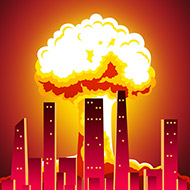
There’s no player character running through the streets here — the city itself is the target, and the weapons practically function as characters in their own right. The Meteor slams down with raw fiery force, good for craters and total building collapse in one hit. The UFO uses a focused beam to lift and vaporize skyscrapers, quieter than the Meteor but arguably just as effective at clearing a block. The Tornado sweeps across the map lifting cars and tearing rooftops off in a chain that spreads outward unpredictably.
Earthquake shakes the ground itself, splitting roads and toppling towers as the tremor rolls through, which makes it a favorite for players who want damage spread across a wide area rather than concentrated in one spot. Laser Cannon offers precision instead of spread, cutting through steel and concrete along a targeted line. Then there’s the Black Hole, which pulls structures toward its center, compressing everything before releasing — and it’s the tool most connected to City Smash’s most-discussed strategy.
Beginners tend to fire off their strongest weapon immediately without thinking about sequencing, which wastes the damage potential of nearly every tool in the lineup.
Sandbox Versus Challenge Modes
City Smash splits fairly cleanly into two ways to play. Sandbox mode drops you into a city with no objective beyond destruction for its own sake, which is where most first sessions happen — there’s something genuinely relaxing about leveling a skyline with no scoreboard watching. Challenge modes introduce actual goals, things like destroying a set number of structures within a time limit or hitting a specific damage total, and these are where the weapon-sequencing strategy actually starts to matter.
Players chasing high damage scores in challenge mode consistently land on the same combo: use the Black Hole first to cluster buildings into a tight group, then detonate an explosive weapon inside that compressed mass. The math behind it isn’t subtle once you’ve tried it — hitting a cluster of buildings does exponentially more damage than hitting the same buildings spread across their normal positions, and once players discover this the sandbox starts to feel like a puzzle instead of a toy.
Early in the game, before players understand clustering, most damage numbers stay fairly low no matter which weapon gets used. Once that technique clicks, the same city can be leveled in a fraction of the moves it used to take.
What Divides the Community on City Smash
Not every player wants strategy layered on top of destruction. A meaningful chunk of the audience openly says they prefer treating City Smash purely as a stress-relief toy, dropping weapons at random without worrying about damage optimization at all, and there’s some pushback in comment sections toward guides that turn something meant to be relaxing into a min-max exercise. That tension between “just let me smash things” and “here’s the optimal build order” comes up in nearly every discussion thread about the game.
There’s also a smaller but consistent complaint that the randomly generated cities can feel repetitive after enough sessions, since the building layouts don’t vary as dramatically as the weapon selection does. It’s a fair point, and it’s the kind of thing that shows up more in longer-term reviews than in first impressions.
If you’re wondering whether City Smash has actual levels the way a mission-based game does, it doesn’t in the traditional sense — sandbox mode has no levels at all, and challenge mode structures its targets as goals rather than a fixed level progression, so the replay value comes from chasing better scores rather than unlocking new stages.
Between the Black Hole’s slow gravitational pull and the Meteor’s single flash of destruction, City Smash gives players just enough tools to turn simple demolition into something they keep coming back to refine.