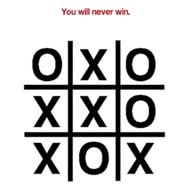
Impossible Tic Tac Toe tells you exactly what you’re up against in its own name — an opponent that has never lost a single game, because the AI behind it doesn’t make mistakes. Tic-tac-toe has been a solved game for decades; every possible line of play has been mapped out, and this version puts you across the board from an opponent that has memorized all of it.
Why “Impossible” Isn’t an Exaggeration
The AI here isn’t tuned to be hard, it’s tuned to be perfect, which means it never opens a square that gives you a path to a forced win and never fails to block a threat the instant one appears. Against an opponent like this, tic-tac-toe stops being about clever tactics and becomes a game about avoiding your own mistakes, since the AI is guaranteed not to make any of its own. The best you can force, with genuinely flawless play, is a draw — a true win against a perfect opponent isn’t a skill issue, it’s mathematically off the table.
That framing is exactly what makes the game land as a troll experience rather than a frustrating one. You’re not losing because the game is cheating or hiding information from you; you’re losing because tic-tac-toe, played correctly by both sides, always ends in a draw, and “correctly” here means without a single lapse. Most players’ first instinct is to test the AI for a gap in its logic, and watching that search fail every single time is the actual point of the game.
Finding the Draw
Reaching a draw against Impossible Tic Tac Toe requires understanding a handful of core ideas: controlling the center square when it’s available, recognizing when your opponent has created a “fork” — two simultaneous winning threats you can’t block at once — and never opening a line that lets the AI set one up against you. None of this is complicated in isolation, but doing all of it correctly for every single move, with zero room for a careless click, is where most players actually fail.
What tends to surprise new players most is how quickly they were losing before switching to this ruleset — most casual tic-tac-toe play against another human is full of small mistakes neither side punishes, and this game simply removes that margin entirely, exposing habits that never mattered until now.
Impossible Tic Tac Toe isn’t really testing whether you know the rules of tic-tac-toe — everyone already does. It’s testing whether you can execute those rules without a single slip, against an opponent built specifically to find and exploit the slip the moment it happens. Getting to a draw, over and over, without ever managing an actual win, turns out to be a strangely satisfying kind of mastery on its own.