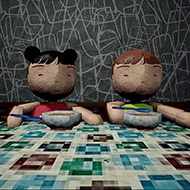
Meccha Chameleon looks like a lighthearted coloring app where you dab paint on a blank character, but it plays like a genuinely tense stealth game where holding still for four extra seconds is the difference between surviving the round and getting tagged.
Hunters, Chameleons, and the Painting Mechanic
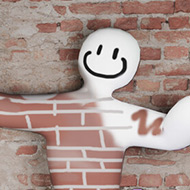
Every round of Meccha Chameleon splits players into two roles: chameleons, who start as plain white bipedal characters, and hunters, who have to find them before the timer runs out. The core mechanic is painting: chameleons pick colors and patterns to match a wall, a poster, a piece of furniture, or a shadow, then hold a pose that sells the illusion. It sounds simple until you’re crouched behind a vending machine trying to match a color you only glanced at for two seconds.
Players who lean into pose selection tend to outlast players who only focus on color matching, because a chameleon with the right paint but an awkward silhouette still reads as a person-shaped blob against a flat surface. The game rewards noticing small details in a level, like a chipped edge on a poster or a shadow that doesn’t fall evenly, since those imperfections are exactly what a sharp-eyed hunter will look for.
Hunters, meanwhile, aren’t just wandering randomly. Good hunters learn to scan for color seams, edges where a chameleon’s paint job doesn’t quite line up with the real surface behind it, and they learn which corners of a map get overused by hiders in a hurry.
What New Chameleons Get Wrong
New players in Meccha Chameleon almost always rush the paint step, grabbing the first close-enough color and hiding in the open instead of scouting the room first. That instinct gets punished fast, because hunters develop a sense for which spots get picked over and over, and an obvious hiding location with a slightly-off paint job is the first thing they check.
Another early mistake is picking a hiding spot near the room’s entrance, where hunters naturally look first out of habit. Experienced chameleons drift toward the edges of a level or awkward vertical surfaces, since climbing and clinging to walls and ceilings is part of the movement kit and most new players forget to use it.
There’s also a tendency to move at the wrong moment. A chameleon that’s already blended in and gets spooked into shifting position when a hunter walks by often draws more attention than one that simply stayed frozen and trusted the paint job.
Infection Mode and How Rounds Escalate
Room hosts can choose from a handful of match types, and Infection is the one that changes the pace most dramatically. In Infection, a hider who gets tagged doesn’t just lose, they flip sides and join the hunters immediately, which means the hunting team snowballs in size as the round goes on. Early on it feels manageable with only one or two hunters roaming, but by the time five or six former chameleons have joined the hunt, the map feels a lot smaller than it did at the start.
This escalation changes how players approach hiding spots. A location that felt safe against a single hunter becomes a liability once the search team triples, so strong Infection players often relocate mid-round rather than committing to one paint job for the whole match.
Divisive Points in the Community
Not everything about Meccha Chameleon lands cleanly with its player base. A recurring complaint on Steam discussions is that upper-body movement while hiding feels restricted compared to how freely characters move in the pre-match lobby, and some players feel that limits how creative a pose can actually get once a round starts. It’s a small thing, but it comes up often enough in reviews that it’s clearly a real friction point rather than a one-off complaint.
There’s also debate over public lobbies versus private ones. Public matches fill fast and keep the pace lively, but some players prefer the coordination and slower pacing of a private room with friends, especially for Infection rounds where team size shifts the whole strategy.
Maps, Streaming, and Growing Fast
The game has been adding new official maps since launch, including a Greece-themed stage that gave chameleons a new set of surfaces and colors to work with. Meccha Chameleon has also leaned into its popularity with streamers, openly welcoming gameplay videos and viewer-participation formats where a host runs a public server for their audience to join.
That streamer-friendly design partly explains how fast the game grew. It crossed 15 million copies sold within weeks of release and hit a peak of roughly 340 thousand concurrent players, numbers that put it among the fastest-selling releases of the year. On Steam, user reviews have stayed Very Positive, with the vast majority of recent feedback landing positive despite the ongoing complaints about lobby movement.
- How does the color-matching actually get judged in Meccha Chameleon? The game checks how closely your painted pattern and pose match the surrounding surface, factoring in both the color accuracy and how well your character’s silhouette blends with the object or wall you’re mimicking, so a good color choice with a bad pose can still fail.
- Why does Infection mode feel so different from standard rounds? Because tagged hiders convert into hunters instead of being eliminated, the hunting team grows throughout the round, which forces chameleons to think about relocating and adapting their hiding strategy as the map gets more crowded with seekers.
- Are there specific maps better suited to beginners? Newer official stages like the Greece map introduce fresh textures and objects that even experienced players are still learning, so beginners aren’t necessarily at a disadvantage there the way they might be on older, more memorized maps.
Meccha Chameleon keeps its rules simple enough to explain in one sentence, but the gap between a chameleon who freezes near the entrance and one who’s climbing a wall in the Greece map with a perfectly matched paint job is enormous. Whether you’re chasing a snowballing Infection round or just trying to outlast a single hunter in a public lobby, the game’s whole identity rests on that one tense standoff between a painted-still character and a hunter’s eye scanning for the seam that gives it away.