Minesweeper looks like a quiet logic puzzle sitting still on a grid, but it plays like a countdown where one wrong guess ends everything you’ve built. Every tile you clear is proof you read the numbers correctly. Every tile you get wrong ends the board instantly, no partial credit, no second chance on that square.
Reading Numbers Instead of Guessing
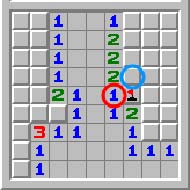
Every revealed tile that isn’t a mine shows a number, and that number tells you exactly how many mines are hiding among its immediate neighbors. The entire game is built on cross-referencing these numbers against each other until you can prove, tile by tile, where a mine has to be and where it can’t possibly be. On a well-played board, guessing should be rare — most of a solve comes from working out that a “1” already satisfied by a flagged neighbor means every other adjacent tile must be safe.
Chording: once you’ve flagged all the mines a numbered tile is pointing to, clicking both mouse buttons on that number at once — or double-clicking it, depending on the version — automatically opens every remaining unflagged neighbor in one move, which is the technique experienced players lean on to clear a board quickly instead of opening each safe tile one at a time.
When the Numbers Run Out
The honest, often-debated part of Minesweeper is the 50/50 guess — a situation late in a board where the remaining logic genuinely can’t tell you which of two tiles is safe, and you have to pick one anyway. Purists disagree about how often a well-generated board should produce this situation at all, since some players consider any true guess a design flaw and others treat it as an accepted part of the risk. Either way, modern versions guarantee your very first click can never be a mine, which at least keeps the coin-flip moments to the endgame instead of the opening move.
Difficulty scales almost entirely through grid size and mine density rather than new mechanics — the Expert board’s 99 mines packed into a 30×16 grid create far denser number clusters than Beginner’s sparse 9×9 layout, which is why solving Expert consistently takes real pattern recognition instead of the light logic a Beginner board asks for.
Is the first click in Minesweeper ever a mine?
No, in standard modern implementations the board is generated after your first click, guaranteeing that first tile and its immediate area are always safe.
What’s the fastest way to clear a board once you’ve flagged the mines nearby?
Chording — clicking a satisfied number to auto-reveal all its remaining unflagged neighbors at once — is the standard technique competitive and speed-focused players rely on.
Why does Minesweeper sometimes force a guess with no logical answer?
On some boards, especially smaller or unluckily generated ones, the remaining information genuinely doesn’t rule out every possibility, leaving a true coin-flip tile — a point of ongoing disagreement among players about how boards should be generated.
Minesweeper’s whole appeal sits in that tension between certainty and risk. Most of a good run is quiet, methodical number-reading, right up until the board hands you a genuine guess and your entire clear depends on a tile you can’t actually solve for.