You wake up inside a body that was never yours, wired into systems you did not sign up for, and the first thing No More Future asks you to do is decide whether that matters. A terminal diagnosis put you here. The transplant saved the part of you that could still think, still remember, still ask questions, and dropped it into a chassis built for a future America that looks nothing like the one you left behind. Nobody around you can say for certain whether the person walking through these late 22nd-century streets is still you, or a very convincing echo running on borrowed hardware.
Waking Up as Someone Else in No More Future
The setup is simple to state and hard to sit with. Brain cancer took the body you were born with, so a transplant moved what could be saved into an android shell, and No More Future spends its opening hours making sure you feel the wrongness of that trade before it lets you get comfortable. You are not handed a tutorial about combat or inventory management. You are handed a mirror that does not show your old face, and the game waits to see how long you stare at it.
Every conversation in the early chapters circles the same question from a different angle: is the mind that survived the transplant still continuous with the one that existed before, or did something new start the moment the old body stopped? The game never rushes to answer this for you. Long-time visual novel readers will recognize the restraint here — dialogue trees exist, but they are used to reveal what you believe about your own continuity rather than to unlock a “correct” ending.
What makes the game land is how ordinary the surrounding world is allowed to be. People still go to work in this future. They still argue about rent and relationships. Your existential crisis is background noise to everyone except the people who knew you before the transplant, and their reactions — relief, suspicion, grief for a person who is technically still standing in front of them — carry more weight than any exposition dump could.
What the Android Body Changes
Physically, the android body in No More Future is not a superpower upgrade. It is a constant reminder. Small interactions — holding an object, sitting in a chair built for a body with different proportions, catching your reflection in a window — are staged to feel slightly off, and the writing leans into that discomfort instead of smoothing it over. You are not playing a cyborg action hero. You are playing someone relearning how to occupy a room.
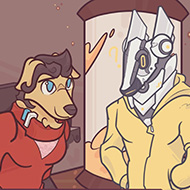
Old friends react to the body before they react to you, and the game tracks this distinction carefully. Some people talk past the android shell entirely, treating you exactly as they did before the transplant, which the narrative frames as its own kind of quiet violence — a refusal to acknowledge that anything happened at all. Others can’t look at you the same way again, and No More Future lets those relationships fray rather than forcing a reconciliation arc.
- Reconnecting with people who remember your old body and struggle to reconcile it with the new one
- Meeting new characters who only ever knew you as an android and have no baseline to compare against
- Navigating a futuristic America where synthetic bodies exist but are still treated as legally and socially ambiguous
Chapters and How No More Future Is Released
No More Future ships in Early Access as a linear visual novel, with new chapters arriving on a roughly monthly cadence rather than all at once. This changes how the pacing lands compared to a finished release — each chapter tends to end on a question rather than a resolution, and players who follow it as it releases end up sitting with unanswered threads for weeks at a time, which mirrors the uncertainty the protagonist is living through.
The episodic structure also means the game is still being written toward its ending, so anyone jumping in should expect a story that is complete in tone and voice but not yet complete in scope. That has not stopped the existing chapters from being read as a finished statement on their own; the themes of identity and continuity hold together even mid-story.
Why Players Keep Talking About This One
Community discussion around the game tends to split into two camps: readers who want firm confirmation that the protagonist is “still themselves,” and readers who think that question is the point and shouldn’t ever get a clean answer. Neither camp is wrong, exactly — the game is written to sustain both readings, and that ambiguity is one of the more debated aspects among people following the Early Access chapters.
The heavier subject matter — death, suicide, depression, anxiety, existential dread — is handled directly rather than hinted at, and some players find individual chapters difficult to sit through for that reason. The game does not soften these topics for pacing, which is part of why it has built a loyal following despite still being unfinished.
Common Questions From New Players
- Is No More Future finished, or still being written? It’s in Early Access, releasing new chapters on a roughly monthly schedule, so the ending has not been published yet even though the existing chapters read as a complete arc on their own.
- What is No More Future actually about? You play someone whose mind was transplanted into an android body after a terminal brain cancer diagnosis, and the game follows them rebuilding a life in a late 22nd-century America where nobody, including the protagonist, can say for certain whether the person who survived the transplant is still “them.”
- Does No More Future have multiple endings or branching paths? Dialogue choices shape how the protagonist relates to the people around them and how they process their own transplant, but the game is structured as a linear visual novel rather than a branching-path story chasing different endings.
No More Future is not trying to be comfortable, and it never pretends the android body is a fresh start instead of a wound. By the time you’ve sat through a few chapters, the game has stopped asking whether you’re still you and started asking what you’re going to do about it either way — which is a harder question, and a better one.