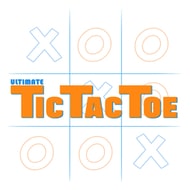
In Ultimate Tic Tac Toe you start with nine tic-tac-toe boards arranged in a 3×3 grid of their own, and the very first move you make determines not just a square, but which entire board your opponent is forced to play in next. What looks like a simple expansion of a childhood game turns out to be a genuinely deep strategic puzzle, once you realize every local move has a global consequence.
Nine Boards, One Rule That Changes Everything
The core twist is simple to state: whichever square you play within your current small board sends your opponent to the corresponding board in the larger 3×3 grid. Play in the top-right square of your board, and your opponent’s next move has to happen in the top-right board overall. This single rule transforms the game completely — you’re no longer just trying to win the board in front of you, you’re trying to control where your opponent is forced to go next, sometimes sacrificing a strong local position specifically to send them somewhere worse.
Winning three small boards in a row — horizontally, vertically, or diagonally across the larger grid — wins the overall game, which means individual small-board victories only matter in relation to the ones around them. A board won in isolation, disconnected from any larger line, can end up being a wasted effort if it doesn’t contribute to the bigger picture.
The Open Move Exception
The one wrinkle to the “your move sends them there” rule: if the board you’d normally send your opponent to is already won or completely full, they get to move anywhere on the entire grid instead. This exception matters more than it seems — strong players deliberately fill or win boards specifically to create these open-move situations at moments that favor their overall position, turning what looks like a side effect into a real tactical tool.
- Play a move in your current small board
- Your opponent is sent to the corresponding board in the larger grid
- If that board is already decided, they get to move anywhere instead
- The overall game is won by claiming three small boards in a line across the full grid
Thinking Two Layers Ahead
What separates strong Ultimate Tic Tac Toe players from casual ones is the habit of evaluating every move on two levels simultaneously: is this a good square within the small board, and is sending my opponent to that corresponding board actually safe for me? A locally “obvious” move can be a serious strategic error if it hands your opponent a board they were already positioned to dominate. This double-layered thinking is the game’s real skill ceiling, and it’s why the game keeps a small but dedicated strategy community engaged well past what its simple rules would suggest.
Why It Rewards Patience Over Speed
New players tend to rush toward winning individual small boards without considering where each move sends their opponent, and that impatience is almost always the difference between a strong player and a beginner in this game. Slowing down to trace the consequence of a move — not just what it does to the current board, but where it sends the game next — is the single biggest jump in skill available, and it’s learnable within just a handful of games once you start looking for it deliberately.
Ultimate Tic Tac Toe takes a game most people consider fully solved and unsolved it completely, just by adding one rule that connects every board to every other. By the time you’re several games in, you’ll stop seeing nine separate tic-tac-toe boards and start seeing one interconnected system where every square is really a question about where you want your opponent to go next.