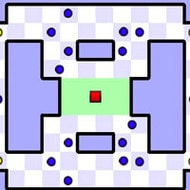
World’s Hardest Game 3 is a demanding reflex-based challenge where every movement matters and every second can decide success or failure. Players guide a small shape through tightly designed obstacle courses filled with moving hazards, narrow paths, and unpredictable timing patterns. The experience is built around repetition, learning, and perfect execution, making each completed stage feel like a true achievement in World’s Hardest Game 3.
Level Design: A Constant Test of Control
Each stage in World’s Hardest Game 3 is structured to test a different aspect of player skill. Some levels focus on tight corridors where even slight misalignment leads to failure, while others introduce moving patterns that require careful observation before acting. The difficulty is not only in speed but also in understanding how obstacles interact within the space. In World’s Hardest Game 3, success often comes from patience rather than rushing forward.
- Pattern-based hazards: Many obstacles follow repeating cycles that must be learned before passing safely.
- Narrow safe zones: Small areas require precise positioning to avoid contact with moving elements.
- Multi-step navigation: Some sections demand completing several timing-based actions in sequence without mistakes.
Progress Strategy: Learning Through Repetition
Progress in World’s Hardest Game 3 depends heavily on memory and adaptation. Players rarely succeed on their first attempt, as each failure reveals important information about timing and movement patterns. Replaying sections helps build familiarity, turning chaotic obstacle layouts into predictable systems. Over time, the game becomes less about reaction and more about controlled execution of learned routes.
- Trial learning: Each failed attempt provides insight into safe timing windows and movement gaps.
- Route optimization: Players can gradually discover more efficient paths through complex sections.
- Consistency training: Repeating difficult segments improves precision and reduces hesitation.
Advanced Techniques and Player Approaches
Experienced players of World’s Hardest Game 3 often develop personal strategies to handle extreme difficulty spikes. Instead of relying purely on reflexes, they break down levels into smaller parts and focus on mastering each section individually. This approach reduces stress and improves overall consistency, especially in later stages where mistakes become more punishing and timing windows are extremely tight.
- Segment practice: Dividing a level into smaller parts makes difficult patterns easier to learn.
- Controlled pacing: Moving deliberately instead of rushing reduces unnecessary errors.
- Timing memorization: Repeated exposure helps internalize movement cycles of hazards.
Why Players Keep Returning
Even with its extreme difficulty, World’s Hardest Game 3 remains engaging because of its clear structure and skill-based progression. Each completed level feels earned, and each failure brings the player closer to mastery. The game encourages persistence, rewarding those who refine their timing and improve their control. World’s Hardest Game 3 is ultimately about overcoming frustration through precision, patience, and determination.
- Skill improvement loop: Continuous retries naturally build better reaction and planning skills.
- Clear challenge feedback: Failures clearly show what needs to be improved.
- Satisfying completion: Finishing a difficult stage delivers a strong sense of achievement.